Ghosts and physical traces
American WomanGhosts and physical traces names the novel’s recurring tension between absence and material remainder. The past seems to persist in fingerprints, marks on household objects, and memories attached to places, yet none of these traces guarantees that the person associated with it remains recoverable. A fingerprint may be evidence, a misleading fragment, or simply an impression left by someone unknown; a remembered sound can endure after a relationship has disappeared. The novel makes haunting less a matter of supernatural certainty than of the fragile, often incomplete evidence through which people try to establish what happened and who was there.
The farmhouse as an archive
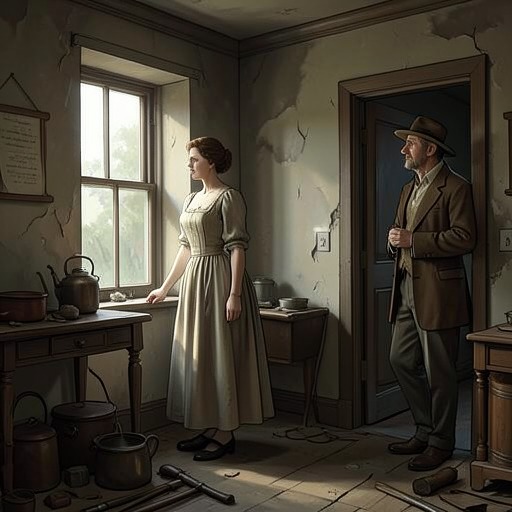
The farmhouse’s emptiness first appears to be an interval in which human traces are giving way to other kinds of marks. After the tenants leave, mice scatter pellets near the edges of rooms, disturb a box of black pepper, and gnaw at soap and toilet paper. Their activity is abundant but hard to interpret: they damage some things and leave comparable things alone. The owner returns after Labor Day in 1974, finds the house clean apart from the mice, secures it for winter, and leaves without changing the locks. The setting is not frozen in a pristine past. It is being altered by ordinary time and by creatures whose activity has no readable human intention.
When an investigative team enters the cold house, the lead fingerprint expert considers how bodies leave minute residues through the course of an ordinary day. Such remnants can make a body seem to continue after it is gone, while fingerprints have the additional practical use of identifying a person. The expert’s own breath is briefly visible in the cold air, an immediate but vanishing image of presence. This bodily apparition supplies a scale for the investigation: some traces can be seen only for an instant, while others may persist on a surface long after their maker has left.
The search turns the house into a contested archive. The team looks through frames, cupboards, floorboards, and household objects for places where something could have been concealed. The expert also recognizes that the fugitives had learned to leave less behind. Their earlier stays had produced conspicuous disorder, including notebooks, spoiled food, clothing, cigarette butts, and graffiti; now the house’s unusual cleanliness suggests a deliberate effort to erase evidence. Yet erasure does not make the building empty of meaning. The investigators’ search and the fugitives’ precautions mirror one another: one activity seeks to recover traces, while the other tries to prevent them from remaining legible.
Evidence that does not identify its maker
A partial fingerprint on a metal cot frame offers a lead, but the lead is already cold: the unknown man may have been in the house with the girls or alone, and the house has been empty since at least September. The uncertainty matters as much as the print. A physical mark can establish contact without establishing its circumstances. It narrows the field of inquiry while leaving open the question that gives the trace its force: whose presence does it actually record?
The mattress produces a more striking but no more conclusive discovery. A thick patch of tape comes away with newspaper attached from a hole in the old mattress. The paper is dated June 12, 1974, nearly ten months before the search. On the tape, the team finds several clear prints, including both thumbs and other distinct fingers. Their arrangement suggests a dense record of contact, preserved in layers, and the expert experiences the discovery as a message from an absent person. But the prints belong neither to the three fugitives nor to the farmhouse’s owner. Someone had used the newspaper to plug the mattress long before the investigation. The evidence is vivid, carefully preserved, and unrelated to the people the team hopes to find.
This reversal makes the novel’s physical traces resistant to simple interpretation. Their legibility is not the same as relevance: the fingerprints can be distinguished from one another, and the newspaper can be dated, without solving the fugitives’ story. A trace may appear to address the investigator and still have been left by a stranger. The house therefore yields both a partial route toward the past and a warning about the limits of forensic knowledge. What survives can be materially precise and narratively incomplete.
Memory’s surviving fragments
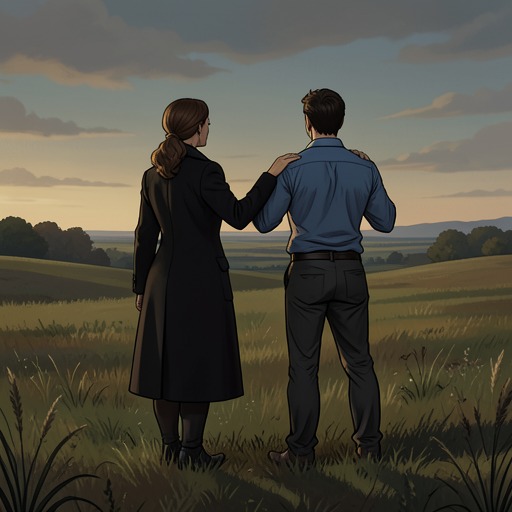
The same tension appears in Jenny’s later recollections. She remembers sitting with Pauline on their porch at dusk and watching birds repeatedly rise from and settle back into their roosts. The memory has the particular texture of shared time, but Jenny cannot reconcile it with the public image of Pauline that appears on television. Celebrity seems to create a feeling of nearness while presenting an image that is diffuse and unlike the small, solid person Jenny once knew. The contrast is not simply between truth and falsehood: the public image exists, but it cannot restore the intimacy that produced Jenny’s memory.
Other remnants remain sharply attached to Jenny’s mind: the oval track worn into the pasture, the sound of Juan’s gun carried on the wind, and the association of a killing with the seat of The Bug. These fragments have different forms—a mark in a landscape, a remembered sound, and a trace tied to a car—but together they show how the past returns through specific material or sensory details rather than as a complete account. Jenny can recall them as persistent impressions, yet their persistence does not undo what happened or make it fully present again.
The distinction between those memories and Pauline’s disappearance gives the motif its personal consequence. Jenny describes Pauline as the one who has long vanished, even while images and memories of her continue to circulate. The surviving fragments do not make the relationship whole: a television image cannot coincide with the remembered person, and a recollection of shared evenings cannot restore them. The absence is most palpable precisely because other traces endure.
Presence without recovery
Across the investigation and Jenny’s memories, the novel separates persistence from recovery. Mice remake the farmhouse after its tenants have left; dust and bodily residue may deteriorate; tape preserves fingerprints that identify no one relevant to the search; and Jenny’s recollections preserve details without bringing Pauline back into her life. These are not equivalent kinds of evidence, but each complicates the hope that a remnant will deliver the absent person intact.
The motif also gives ordinary objects an unstable role. A cot frame, a mattress, newspaper, household furnishings, a pasture track, and a car can become meaningful because they have been touched, used, or remembered. Their significance is not automatic: investigators must interpret them, and Jenny’s memory remains personal rather than a forensic record. The contrast keeps the novel from treating objects as transparent witnesses. They register contact and change, but the meaning attributed to them remains partial and subject to error.
Ghosts and physical traces thus describe a world in which the past is neither simply gone nor securely preserved. Its remains can provoke investigation, recognition, or grief, but they cannot guarantee certainty or reunion. The farmhouse’s stray marks and the traces held in Jenny’s memory alike make absence materially perceptible while showing why perception is not possession: something can remain after a person has gone, without giving that person back.